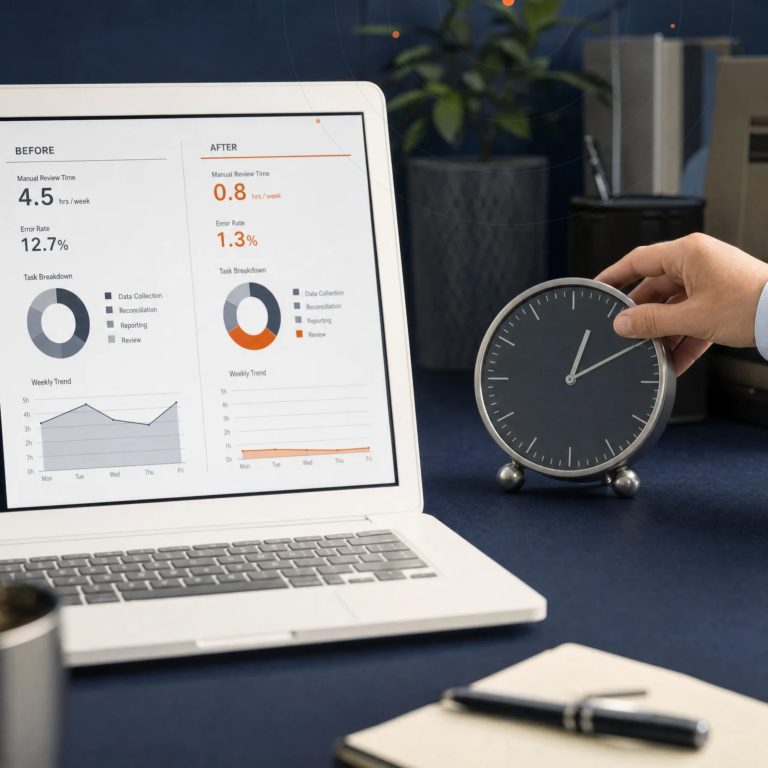


Ask a compliance officer at most GCC banks how many systems touch their GRC system today, and the honest answer is usually more than they’d like to admit. A risk register in one tool. AML case management in another. Policy documents in SharePoint. Audit findings in a spreadsheet someone inherited three roles ago. Board reporting built by hand from all four, every quarter, by someone who has memorized which numbers usually don’t match on the first try.
None of these tools were bad choices individually. Each solved a real problem at the time it was bought. The issue is what happens between them, or rather, what doesn’t happen between them. A control gets updated in one system and nobody tells the other three. That gap is where audit findings, board reporting errors, and slow regulator responses actually come from.
This is a practical look at what it takes to move from that state to a single connected GRC system, using tools most GCC banks already have licenses for.
What “Disconnected” Actually Looks Like Inside a Bank’s Compliance Function
Disconnection rarely looks dramatic day to day. It looks like a compliance analyst manually re-entering the same control status into three different trackers because none of them talk to each other. It looks like an internal auditor cross-referencing a risk register against a separate incident log to figure out whether last month’s fraud case was ever formally scored as a risk event. It looks like a CRO asking “are we sure this number is current?” in every board meeting, because the honest answer is nobody fully trusts the reconciliation.
Individually, none of these moments cost much. Compounded across a compliance team of fifteen people over a year, they cost a meaningful share of the department’s total working time, time that should be going toward actually managing risk rather than reconciling records of it. Industry research on compliance automation backs this up: teams running connected, automated compliance workflows report meaningfully lower audit preparation time than teams still reconciling disconnected systems by hand, since automation replaces the manual reconciliation work rather than adding another dashboard on top of it.
For GCC banks specifically, this compounds further. The Central Bank of Bahrain and equivalent regulators across the region expect consistent, reconcilable reporting across AML, prudential, and governance obligations, not four slightly different versions of the same number depending on which system produced it. A disconnected setup doesn’t just cost internal time, it creates the exact inconsistency regulators are most likely to flag.
What a Connected GRC System Actually Requires
“Connected” doesn’t mean one giant application that replaces everything overnight, and it’s worth being direct about why: the GRC software market itself is moving away from that assumption. Monolithic, single-vendor GRC platforms are becoming harder to justify as banks operate across more jurisdictions and frameworks, which means the more realistic goal for most GCC banks is connecting what they already run, not consolidating onto one new system that has to do everything. “Connected” means three specific things are true.
One data model, not five
Every disconnected GRC setup eventually hits the same wall: the same control, the same risk, or the same regulatory obligation exists as separate, slightly different records in separate systems. A connected system starts by defining one source of truth for that data, typically through a shared data layer other tools read from and write to, rather than five silos that each think they’re authoritative.
Automated evidence flow, not manual re-entry
When a control is tested, that evidence should update everywhere it’s referenced automatically, not get copy-pasted into three trackers by hand. This is where workflow automation earns its keep: a control test completed in one system should be able to trigger an update in the risk register and the audit tracker without a person acting as the integration layer.
Reporting built from live data, not quarterly reconstruction
Board packs and regulator submissions should pull from the same live data the compliance team works from day to day, not get rebuilt from scratch each quarter by someone manually assembling numbers from disconnected sources. If the reporting layer and the working data are the same thing, the “is this number current” question stops coming up.
The Role of Microsoft Dataverse and Power Platform in Connecting Existing Systems
For banks already running Microsoft 365, Dynamics 365, or Power Platform, the fastest path to a connected GRC system usually isn’t ripping out every existing tool. It’s connecting them through infrastructure the bank already has.
Microsoft Dataverse integrates data from multiple sources into a single store, which Power Apps, Power Automate, and Power BI can then work from alongside data already available in Dynamics 365. For a bank running risk data in one system and AML case data in another, Dataverse gives both a shared home without forcing an immediate, disruptive migration of either underlying tool. It also brings a genuine security model with it, including role-based, row-based, and column-based access control, which matters for a bank that can’t have every compliance analyst seeing every AML case file by default.
Once that shared data layer exists, Power Automate’s Dataverse connector becomes the connective tissue. Cloud flows can trigger automatically when a row changes, such as a control status update, and push that change into every downstream system that needs to know about it, replacing manual re-entry with a rule that runs itself. On the evidence and audit trail side, Microsoft Purview’s compliance solutions add activity auditing and records management on top of that same connected data, so the trail of who changed what, and when, doesn’t depend on someone remembering to log it separately.
This is a materially different starting point than most point-solution GRC tools, which arrive as yet another disconnected island unless a bank pays for custom integration work on top.
A Practical Migration Path
Banks that try to consolidate everything in one project tend to stall, because the scope becomes unmanageable and the risk of disrupting live compliance operations feels too high to move fast. A phased approach works better in practice.
Start by mapping what actually exists: every system that currently holds risk, control, or compliance data, and where the duplication and manual re-entry points are. This sounds obvious, but most compliance teams have never had this mapped in one place, which is itself a sign of how disconnected the current state is.
From there, define the single data model each control, risk, and obligation should live in, and migrate the systems causing the most manual reconciliation pain first, not necessarily the oldest or the newest ones. Automate the evidence flow between the newly connected systems before touching reporting, since reporting built on top of an unreliable data flow just automates the wrong numbers faster. Reporting and dashboards come last, once the underlying data can actually be trusted to be current.
What Not to Do
A rip-and-replace approach, swapping every existing tool for a single new platform in one project, usually costs more in disruption than it saves in consolidation, particularly for a bank that can’t afford a gap in AML monitoring or control testing during a mid-year system swap. It also tends to underestimate how much institutional knowledge is embedded in the workarounds compliance teams have built around their current tools. Connecting what exists is almost always faster and safer than replacing it outright, and it’s the approach that actually matches how GCC banks report acquiring GRC tools in the first place: one point solution at a time, in response to one specific audit finding or regulatory requirement at a time. Fixing the connections between those tools, rather than starting over, respects that history instead of discarding it.
The other trap is treating the migration as purely a technical project owned by IT. The compliance team, not IT, knows where the real reconciliation pain lives, which controls get re-entered manually most often, and which reports take the longest to assemble each quarter. A connected GRC system built without that input tends to connect the wrong things first, technically impressive but not aimed at the reconciliation work that’s actually costing the team time.
Conclusion
A connected GRC system isn’t a single product a bank buys off a shelf. It’s a data model, an automation layer, and a reporting layer working from the same source of truth, built on top of infrastructure most GCC banks already have licensed through Microsoft. The banks that get this right stop treating governance, risk, and compliance as three departments running three sets of disconnected tools, and start treating them as one operational picture that updates itself. That shift shows up first in how fast a compliance team can answer an examiner’s question, and eventually in how much less time gets spent reconciling numbers that should have matched in the first place.
Ready to Connect Your Bank’s GRC Systems?
Global iTS helps GCC banks map their existing risk, compliance, and audit tools and connect them through the Microsoft ecosystem they already run, without a disruptive rip-and-replace project. Contact Us | Global iTS to talk through where your current setup has the most reconciliation pain, or Request A Demo | Global iTS to see a connected compliance data flow in action.